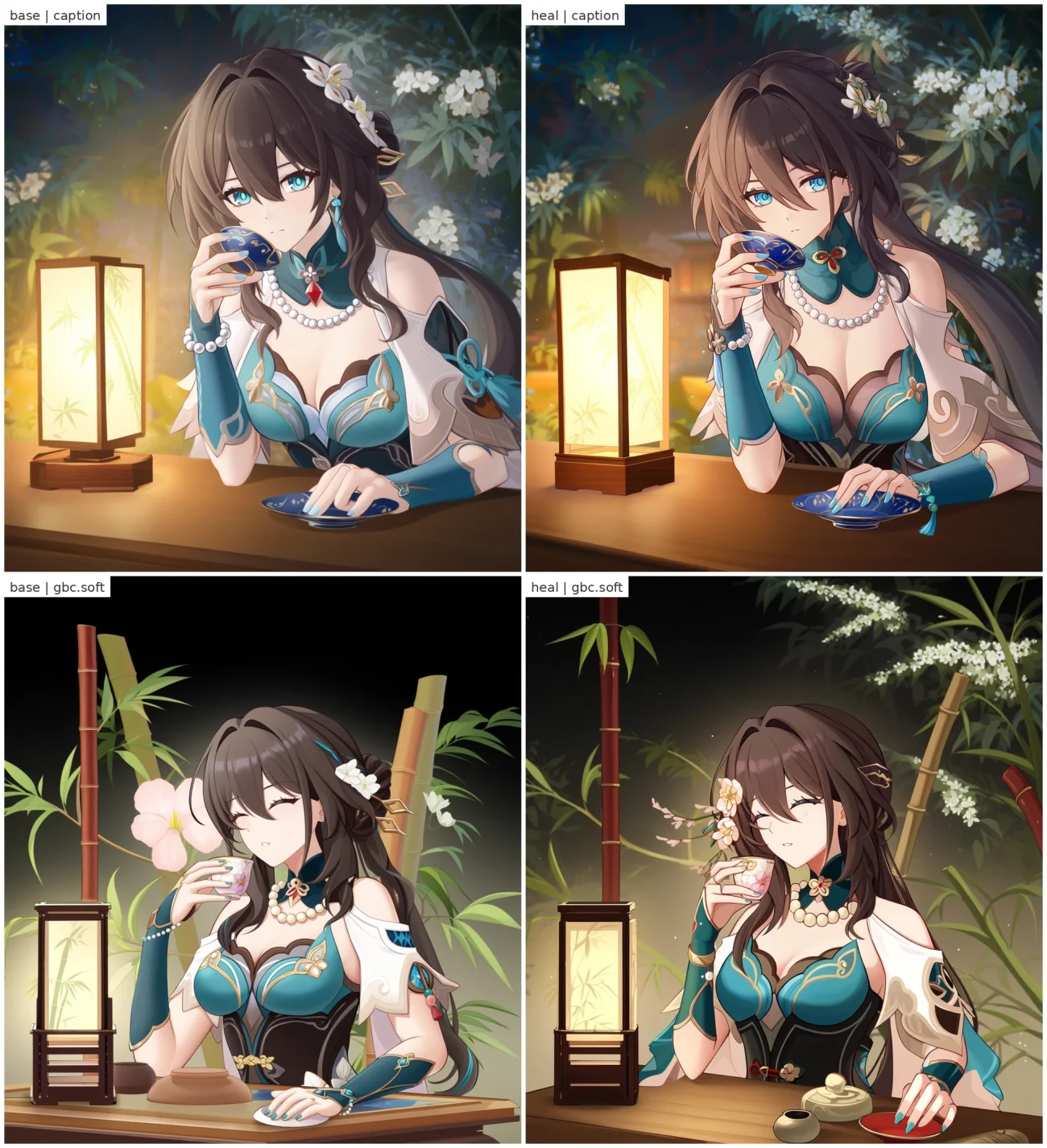
KBlueLeaf’s MOSS-Image-heal is a new fine-tune aimed at an unusually specific problem: making MOSS-Image-Base numerically easier to work with while keeping its predictions close to the original. The release changes the transformer, rather than introducing a new text encoder, image decoder or editing interface. Its strongest evidence concerns internal activation magnitudes and weight outliers. It does not establish a general improvement in image quality.
The Hugging Face repository was created on November 4, 2026, and its latest recorded commit was also on November 4. A November 8 review found 60 likes and a trendingScore of 59 in the platform’s trending-model API. Those are point-in-time attention signals, not a count of successful deployments. No November 8 release or discussion event was established in the retrieved records. This analysis therefore uses a disclosed recent-release fallback, rather than presenting the model as a same-day launch or a viral breakthrough.
The practical question is whether a base model with smaller internal values can become a more dependable starting point for later training. The MOSS-Image-heal model card supplies a concrete case for investigating that question, alongside enough limitations to resist a simple better-model headline.
What MOSS-Image-heal changes
The author describes the release as a full fine-tune of MOSS-Image-Base. That description has an important boundary: the transformer is trained except for its frozen text refiner. The text encoder, tokenizer, VAE, scheduler and pipeline code remain the official base-model components. This is a replacement backbone within an existing generation stack, not an independently rebuilt image system.
OpenMOSS’s base-model documentation describes support for natural-language prompts, tag sequences and JSON layouts. Its standard sampling configuration uses flow-matching Euler, 50 steps, CFG 3 and shift 5, with negative-branch layer skipping. Those upstream capabilities explain the inherited environment. They should not be mistaken for newly introduced heal features or for behavior revalidated across every prompt format.
KBlueLeaf provides a Diffusers-format transformer and three single-file ComfyUI exports: bf16, fp16 and int8 ConvRot. The files serve different precision and loading choices. They do not make this a ComfyUI release, and the model should not be confused with the earlier addition of MOSS editing controls to that application. The event here is a separately trained checkpoint published by KBlueLeaf.
Why the residual stream matters
In the author’s investigation, a small group of channels carries a large share of the residual stream’s energy. The residual stream is the running representation that transformer blocks read and update. If some values become very large, a low-precision computation has less room for further growth before reaching the format’s finite range.
The massive-channel investigation argues that these channels are functional, rather than disposable noise. Through RMS normalization, a large channel can influence the scale at which the other channels enter the next computation. Simply shrinking selected channels changes that normalization differently for different tokens. A smaller number is therefore not automatically an equivalent computation.
This explains the choice to train a healed model rather than merely clip the original. The goal is to let the network reorganize its computation while penalizing unwanted magnitudes and preserving useful predictions. That is the author’s technical rationale, supported by probes and earlier experiments in the training repository. Those earlier experiments use different settings and snapshots, so their results cannot be substituted for measurements of this released checkpoint.
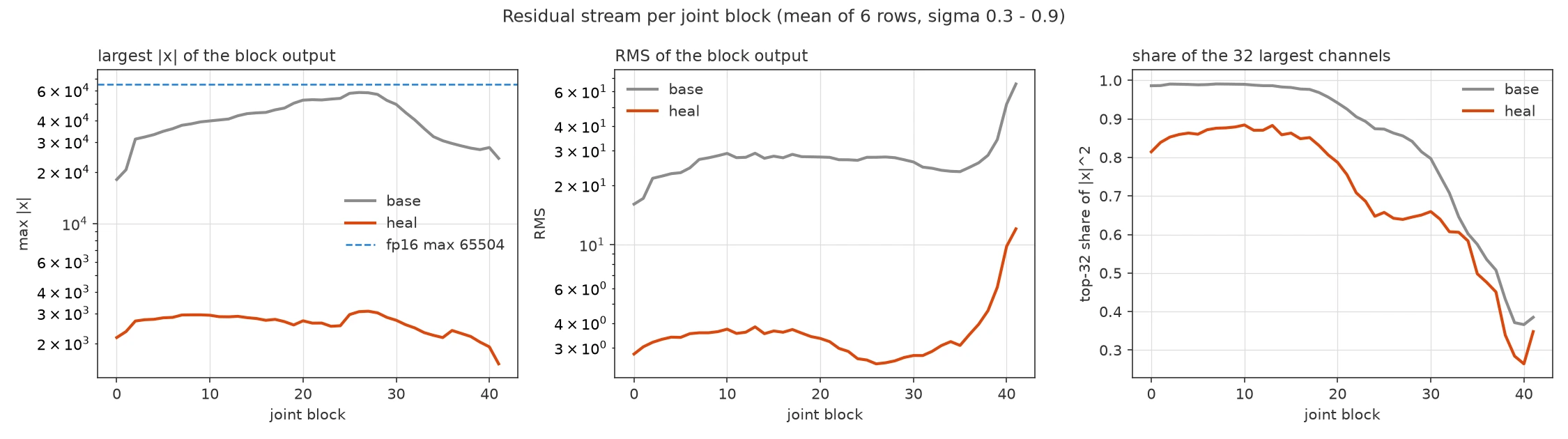
The release reports a largest block statistic of 58,411 for the base and 3,083 for heal, against an fp16 maximum of 65,504. It reports mean stream RMS falling from 27.75 to 3.70. These headline statistics come from six text-image probe rows at approximately 1024-square image area, using fixed noise, bf16 forward computation and fp32 statistics. Per-block values are averaged across those rows.
That last detail matters. The 3,083 headline is not a universal ceiling on everything the model can produce. A separate precision test records a heal stream peak of 3,278 during fp16 computation. Both results support substantially greater observed numerical headroom, but they summarize different measurement procedures. Neither guarantees safety for arbitrary resolutions, prompts, later training updates or runtime kernels.
The fine-tune attacks writes and weights separately
The stream-healing design notes distinguish the accumulated stream from each sublayer’s contribution to it. Penalizing only the accumulated state can encourage cancellation: one block writes a concentrated value and another writes against it. The final state looks less concentrated even though the individual contributions remain concentrated.
The released run instead combines a write-concentration penalty, an RMS penalty and outlier decay with flow matching and distillation toward the frozen base. The write term targets what attention and feed-forward sublayers add to the stream. Its detached denominator is intended to prevent the network from satisfying the ratio merely by enlarging other channels. The RMS term addresses overall stream magnitude.
Outlier decay handles another problem: individual weight elements far above their tensor’s initial RMS. The documented update acts outside the optimizer’s normalized gradient step and gradually reduces excess beyond a threshold. The author’s motivation is that an ordinary loss penalty need not move a very large weight far enough during a conservative fine-tune. The release combines pressure on the computation with pressure on the parameters that a later trainer inherits.
The weight statistics show a selective result, not the disappearance of all outliers. Elements above 64 times their tensor RMS fall from 349 to zero, and those above 32 times fall from 2,621 to 345. But counts above eight and sixteen times RMS increase. The defensible conclusion is that the most extreme tail shrinks under these thresholds. Claiming that every measure of weight concentration improves would contradict the published table.
Preserving predictions is not proving identical pictures
The author reports flow loss of 0.4289 for heal versus 0.4280 for the base and a predicted-velocity cosine similarity of 0.9983 on the probe set. That is evidence of close predictions under the tested conditions. It is not a perceptual similarity score across a broad image benchmark, a human preference study or proof that a seed reproduces the same picture after replacing the checkpoint.
The sample grids make this distinction visible. The author supplies paired base and heal images for caption-style and graph-derived prompts, using 16 steps, CFG 3, shift 5 and seed zero, with the same negative prompt. The examples retain recognizable scene content, while details and composition differ. They demonstrate the proposed continuity more usefully than an assertion of identical output would.
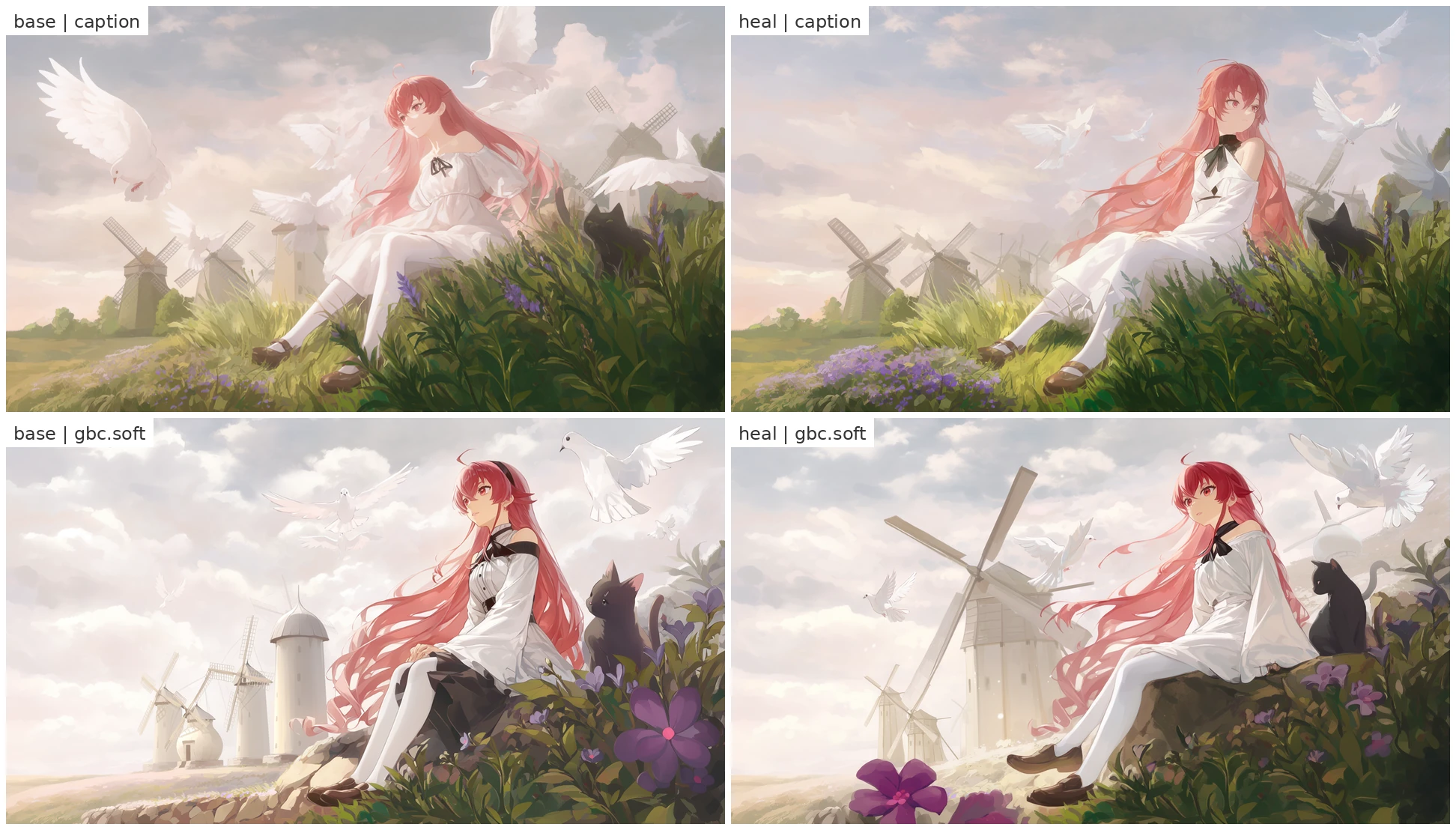
In the windmill comparison, the four panels preserve a red-haired illustrated subject, white birds and a rural setting. The lower panels place the windmills and subject differently; the upper panels also differ in pose and framing. Inspection supports a narrow statement about these particular examples. It cannot establish a success rate, a preferred style or preservation of photographic anatomy.
The training data also limits how broadly to read the examples. The author reports 999,294 Danbooru posts, selected through a normalized quality-ranking procedure, with graph-based captions and multiple prompt formats. The run processes 3.2 million samples over 50,000 steps. This is substantial additional training, not a file-format conversion. It also means the checkpoint has passed through a particular illustration-heavy data distribution while being encouraged to stay near its teacher.
Accordingly, any decision to replace the base for photography, dense typography or other specialized work needs task-specific evaluation. This is an analytical implication of the training and evidence scope, not a report that heal fails those tasks. The retrieved release does not provide the broad comparative evaluation needed to settle them.
What the precision reports establish
The precision table compares each export with the same weights evaluated in fp32, on the six probe rows, using an RTX 3090 and 16-bit matrix multiplications with fp32 accumulation. The reported fp16 heal export has mean relative velocity error of 0.0021, compared with 0.017 for the bf16 heal export. Both record zero non-finite values in these tests.
That comparison needs two boundaries. First, it measures numerical agreement with each checkpoint’s fp32 reference, rather than artistic quality. Second, the base’s fp16 reference row also records zero non-finite values and a similar relative error on the same probes. The release therefore demonstrates additional margin before the fp16 limit, not that the tested base invariably overflows or that heal newly makes those particular forward passes possible.
The numerics documentation separately describes runtime residual folding, stored fp16-fixed weights and an fp32 residual mode. Healing differs from those numerical accommodations because it changes trained parameters and their behavior. The author says heal can run without special residual handling because its measured stream is much smaller. That is a meaningful intended benefit, but subsequent training can change the stream again.
The int8 ConvRot export introduces a further distinction between storage and computation. Its linear weights are quantized while the reported compute paths use fp16 or bf16. The card documents compatibility-oriented layout checks against Comfy-Org’s base export, backed by a JSON report. This supports an export-format claim. It does not establish faster inference, a measured memory saving for an entire application, or universal compatibility with every ComfyUI version.
Early interest is visible; training reliability remains an author claim
A November 5 purpose discussion is more explicit about the intended audience than the sample images. KBlueLeaf says the aim is a base that is easier to fine-tune and reports that some community members already find training more stable and effective. The retrieved thread contains no corresponding training logs, matched configurations or independently reported comparison from those unnamed users.
That makes the statement useful as author intent and secondhand feedback, not a measured community result. The author’s response had six positive reactions when retrieved. A separate November 4 discussion from Hugging Face’s Apolinário describes building a Spaces demo and offering to transfer it to the author. Together with the model’s likes and trending listing, these are concrete signs of early attention. They do not support a claim of widespread production adoption.
The API’s download counter was zero at observation time. That should not be interpreted as proof that nobody obtained or used the model: a platform counter is not a complete audit of all distribution and execution paths. Equally, likes and a demo announcement should not be promoted into usage statistics. The evidence supports interest in a specialized release, with its practical training advantage still awaiting stronger comparative reporting.
How to judge the release without overclaiming
For an existing MOSS user, the sensible evaluation target is a controlled comparison against the base: preserve prompts, seeds, resolution, sampler settings, dependency versions and precision, then examine both outputs and numerical behavior. A later training comparison would also need the same dataset, optimization settings and a record of failures or non-finite values. These are proposed evaluation criteria, not experiments performed for this article.
The distribution paths lower the friction of that investigation. KBlueLeaf documents a transformer swap for the official Diffusers pipeline and single-file loading for the existing ComfyUI model stack. The official Python example uses a custom pipeline with remote-code trust, so an evaluation should review and pin source code rather than treating the model weights as the only dependency. No model was downloaded, no software installed and no inference or training executed for this analysis.
The model card labels the weights Apache-2.0, following the official model. That declaration does not independently establish rights to every training image, depicted character or demonstration artwork. Technical evaluation and rights review remain different tasks. The images accompanying this analysis are attributed source demonstrations and a source chart, not licensed stock assets or evidence of our own generation run.
MOSS-Image-heal is most persuasive as a documented attempt to improve a fine-tuning foundation. Its reports expose the numerical target, show where the extreme values decrease, and retain uncomfortable details such as increased lower-threshold outlier counts and a slightly higher flow loss. The unresolved test is whether that additional numerical margin consistently produces more reliable downstream training without unacceptable task-specific changes. The current release makes that question testable; it does not finish the comparison.
Sources
- KBlueLeaf: MOSS-Image-heal model card, reports and examples
- MOSS-Image-heal repository commit history
- OpenMOSS: MOSS-Image-Base documentation
- KohakuMoss: stream-healing methods and limitations
- KohakuMoss: numerical precision and residual handling
- Author explanation of the model’s intended purpose
Tags: MOSS-Image-heal, MOSS-Image-Base, KBlueLeaf, Generative AI, FP16, Fine-tuning, ComfyUI
Search intent: Informational analysis of a specific new fine-tune, its numerical evidence and deployment limitations