A faster TensorRT engine can come from compiling the same model differently, without changing its weights. NVIDIA’s October 23 technical series explains how its Global Performance Tuner searches those alternatives. The feature, listed in the TensorRT 11.1 release notes, turns internal compiler settings into build routes that developers can compare using complete-engine measurements.
The useful distinction is between choosing a route and proving that its output is acceptable. The tuner can benchmark candidate engines, but accuracy validation is optional. A search that finishes successfully does not, by itself, establish that its fastest engine preserves the quality an application needs.
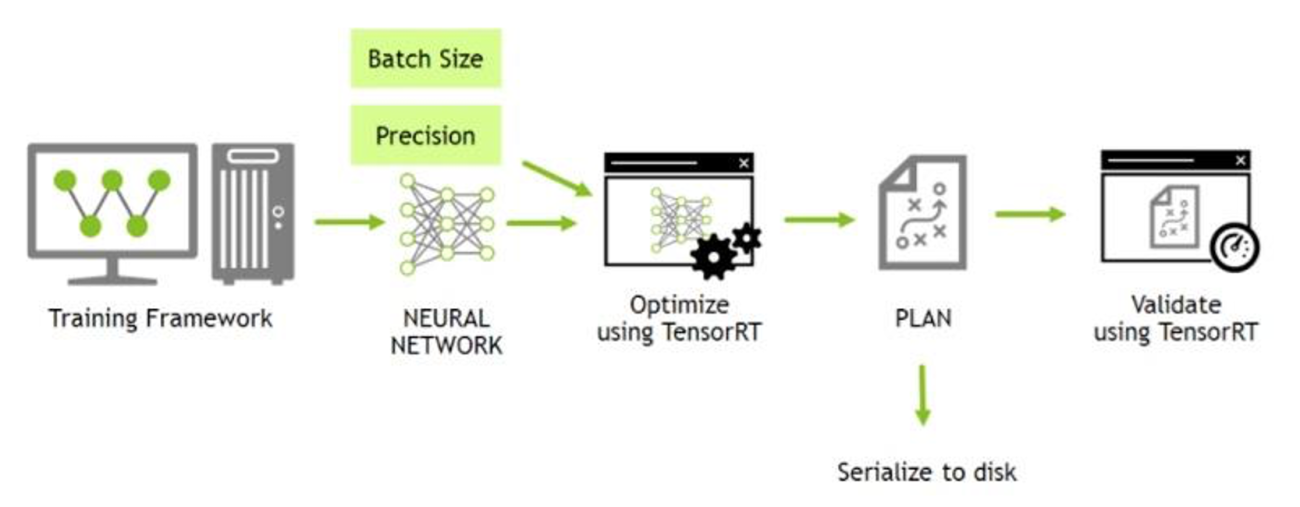
TensorRT compilation involves decisions about fusion, kernel implementations and memory behavior. NVIDIA explains that an individually fast kernel can interact poorly with the rest of a graph. Its default compiler strategy contains heuristics intended to work across many models; a route tailored to one workload can make different choices. The official reference diagram above shows the broader optimize, serialize and validate workflow, rather than the new tuner’s internal search loop.
This makes build time another resource developers can spend on inference. Instead of accepting one default engine, they can build several candidates and measure the result. NVIDIA’s series reports improvements ranging from 1.14x to 1.63x across ten evaluated workloads. Those are vendor-reported comparisons with each workload’s default route, not SekaiTech benchmarks or an expected gain for an arbitrary model.
Decide what can win before searching
The tuning guide makes the accuracy boundary explicit. Reference inputs and outputs, an accuracy threshold and a selected loss metric determine which evaluated engines qualify. Candidates that exceed the threshold are excluded from best-engine selection, even if they are fast. Failed accuracy checks remain in the tuning cache, so rejection is part of the experimental record.
That boundary needs an application decision. A small numerical difference may be acceptable in one workload and unacceptable in another. The documented metrics include mean absolute error, mean squared error and maximum absolute error, as well as other comparisons. Selecting a metric does not supply representative reference data. A narrow example can establish agreement on that example without establishing quality across the intended workload.
Search strategy then determines how much of the candidate space receives a measurement. The available modes make different compromises:
fastmeasures the default baseline and changes one variable knob at a time.fullevaluates combinations across the selected variable knobs, making small search spaces easier to exhaust than large ones.mixedstarts with the fast scan, then combines settings from knobs that produced improvements.
These modes are alternatives for allocating a tuning budget, not quality grades. A one-knob scan can miss interactions between settings. A complete combination search is still complete only for the knobs and values selected. The term Global Performance Tuner should therefore not be read as proof that it has found the fastest engine that could possibly exist.
The cache makes this a cumulative experiment rather than a disposable benchmark. With --tuningCacheFile, completed iterations record the route, measured GPU time and accuracy loss. An interrupted sweep can resume with --continue. NVIDIA’s guide says the continuation command takes the cache file rather than a fresh set of model and route flags, because the original configuration is already recorded there.
Keeping the winning engine matters too. The documentation warns that engine builds are not strictly bit-deterministic: the same route can produce slightly different kernel selections. Its advice is to treat the saved engine as the source of truth, not just the route string. Recording an attractive configuration is weaker evidence than retaining the artifact that actually produced the measurement.
For teams already serving an optimized model, the immediate question is whether a measured inference saving justifies additional compilation and validation work. This is a different layer from the service packaging in SekaiTech’s coverage of Intel inference microservices. TensorRT’s tuner changes how an engine is selected; it does not measure a whole application’s response time or operating cost.
The result to retain is a matched set: the tested model and environment, reference-data acceptance rule, measured candidates and winning engine file. SekaiTech reviewed NVIDIA’s series, release notes and tuning guide rather than running the software. The strongest claim this process supports is the fastest acceptable engine among the routes actually evaluated under those conditions.