
TBC Mischief 1 is now publicly available through fal and OpenRouter, giving creators access to an image-to-video model that The Biological Computing Co. says runs five times faster than its Wan 2.2 base. The October 30, 2026 release puts a price on the company’s biological-computing pitch: OpenRouter lists generation from $0.005 per second at 480p, rising to $0.01 per second at 720p.
The product does not generate clips inside a dish of living neurons. TBC studies neuronal networks in its laboratory, translates discoveries into software and deploys that software on conventional AI hardware. That distinction matters more than the unusual branding. The release offers a new hosted version of an existing video-model family, with an efficiency claim that users can now investigate through public services.
As of November 1, the clearest verified changes are public access, published output limits and resolution-specific pricing. The fivefold speed improvement and equivalent-quality claim remain TBC’s figures. This article examines the launch and its supporting documentation; it does not report a generation test or an independent performance benchmark.
TBC Mischief 1 puts a low entry price on short video experiments
In its October 30 launch announcement, TBC prices a five-second clip at 2.5 cents and 100 clips at $2.50. Those figures match the starting rate on OpenRouter’s model listing, but the resolution qualification is essential: the listing quotes $0.005 per second at 480p and $0.01 at 720p.
At those listed rates, a requested five-second clip costs $0.025 at 480p or $0.05 at 720p. A batch of 100 five-second clips therefore represents $2.50 or $5 in generation charges, respectively. These are calculations from the published per-second rates, not a bill from a tested account. They do not establish the total cost of a finished production.
The distinction is easy to miss because TBC’s announcement emphasizes the lower figure without presenting a resolution-by-resolution price table. It becomes more important beside fal’s documented settings: that endpoint defaults to 720p. A reader should not assume that the release’s cheapest example describes every default configuration across both marketplaces.
TBC also describes Mischief as the lowest-priced image-to-video model on the two platforms. That is the company’s marketplace comparison, not a ranking independently established here. Starting prices can obscure differences in resolution, duration and supported controls. The narrower, checkable statement is that OpenRouter publicly lists the two rates above.
For a creative team, those figures make a plausible case for inexpensive rough drafts. Whether they make Mischief economical for delivery depends on how often a clip survives review. A low price for an attempt is useful; it is not evidence that the attempt will preserve a character, follow a brief or fit into an edit.
The public release has a defined, limited output format
The fal API specification describes an image-to-video service requiring a prompt and a starting-image URL. It offers 480p at 832 by 480 pixels and 720p at 1280 by 720, both landscape, with a documented output rate of 16 frames per second. OpenRouter summarizes the offering as 16:9 video with three- or five-second clips.
Fal adds a useful detail that a headline price does not convey. Its duration choices map onto the model’s frame grid: a requested three seconds produces 49 frames, while five seconds produces 81. The documentation says billing follows the requested duration rather than the slightly longer rendered clip. That is a service-specific explanation, not a claim that every platform implements duration handling identically.
The starting image also needs to fit the output. Fal exposes a center-crop option that preserves proportions and a resize option that stretches the image; center crop is the default. For someone animating an approved composition, that means the framing decision can change before any generated motion is judged. A short clip that looks different from the original image may reflect input fitting as well as model behavior.
These boundaries help explain the intended audience. OpenRouter positions Mischief for ideation, previsualization, moodboarding and variant testing. The public documentation supports discussing it as a short-shot tool. It does not establish a long-form video system, a native portrait-video offering or an audio-generation workflow.
What the neurons contribute, according to TBC
On its company website, TBC describes a discovery process in which researchers encode an AI problem into electrical signals, measure neuronal responses and identify patterns that can be implemented in software. The company calls the resulting approach neuron-derived because it says the computational principles come from experiments rather than a loose analogy with the brain.
For the commercial model, TBC describes a post-training software layer around diffusion transformer blocks. It says the addition increases the underlying parameter count by less than 0.1%. The launch announcement identifies Wan 2.2 as the base and describes the software as proprietary. Public API access should therefore not be confused with a release of Mischief weights or the ability to reproduce its modifications locally.
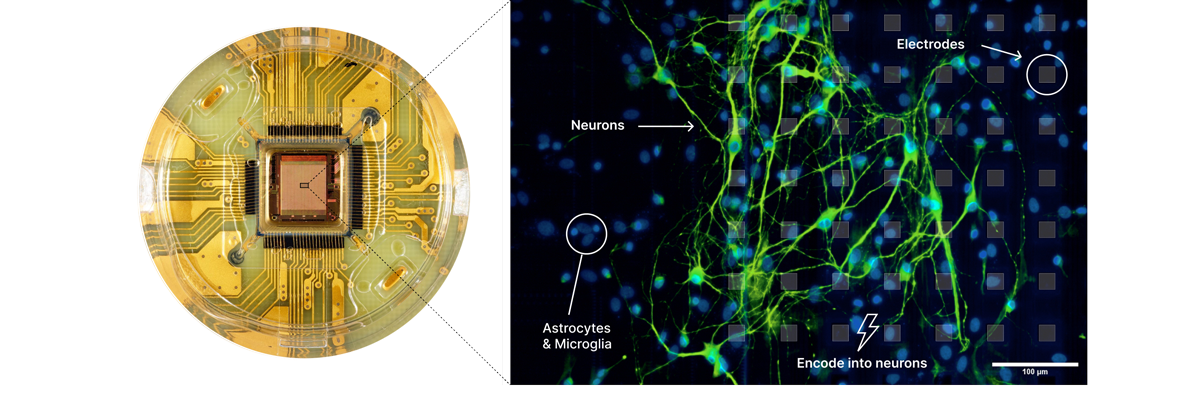
The company explicitly says that the neurons stay in its laboratory. Customers use software on standard AI hardware, not a biological processor connected to each request. This also separates the October release from TBC’s longer-term interest in real-time biological computing. The latter is a development direction, not the hardware requirement for using Mischief today.
The distinction changes what should be tested. The practical claim concerns a digital model’s behavior after a research-informed modification. An unusual discovery process can motivate that modification, but the origin of an idea does not by itself establish better outputs or lower latency.
An earlier research result explains the method, not Mischief’s speed
TBC’s Neural Dynamics Adapter post provides more detail about an earlier experiment using Oasis, an interactive Minecraft world-generation model. It describes living neural networks cultured on high-density arrays with 4,096 electrodes and an adapter of approximately 156,000 parameters. The adapter modifies intermediate representations in the video model.
In that research, TBC trained the adapter on Minecraft video alongside moderate fine-tuning of the base model. It compared the approach with base-model fine-tuning and low-rank adaptation. The post investigates stability during extended autoregressive rollouts, including measurements derived from latent representations. It also acknowledges a narrow environment and the need to evaluate more sampling regimes.
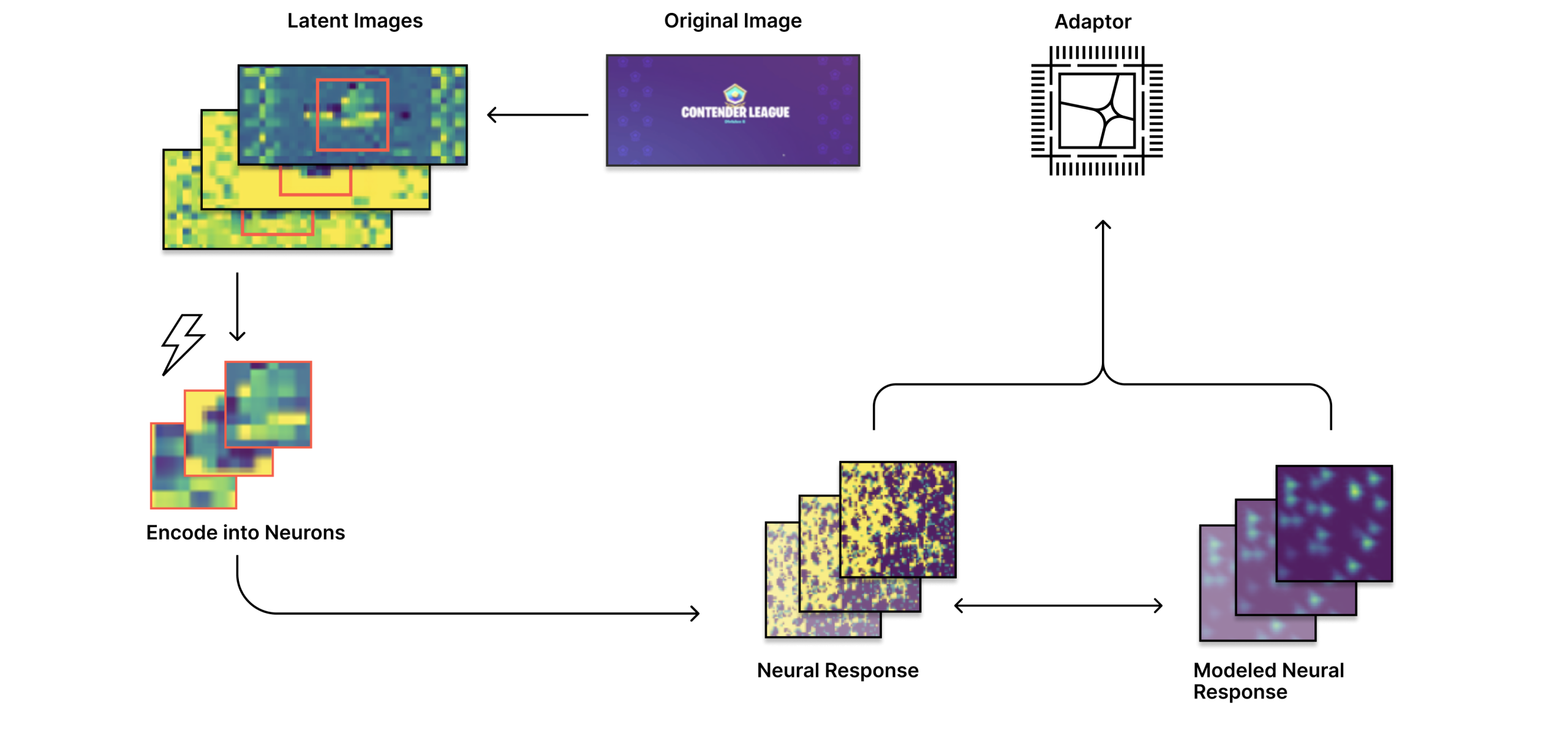
That work gives readers a concrete account of what a biologically derived adapter can mean. It does not supply a controlled performance result for Mischief. Oasis and the commercial Wan-based service are different systems, and longer rollout stability is a different evaluation target from the time needed to generate a short hosted clip.
This is why the research figures should not be carried over as Mischief specifications. The small parameter count in the Oasis experiment, its evaluation conditions and its reported gains belong to that experiment. The commercial product’s own claims need evidence tied to its actual base variant, output settings and serving configuration.
The speed claim still needs a reproducible comparison
TBC’s launch announcement says Mischief matches its base model’s quality while generating video five times faster. Its product page also includes a comparison labeled as TBC GPU benchmarks, showing 142 seconds for Wan 2.2 and 12 seconds for Mischief. The page says the displayed comparison is sped up and that actual generation times vary.
Those figures are useful disclosures, but they are not a complete benchmark protocol. The product page does not identify enough matching conditions to reconcile that particular example with the broader fivefold headline. The two presentations should not be treated as interchangeable measurements. Neither should a viewer infer a guaranteed completion time from a promotional animation.
A reproducible comparison would identify the exact base model, hardware, resolution, clip length and sampling settings. It would distinguish time spent computing from request-level delay and report results across multiple inputs. A quality assessment would need to examine the same tasks rather than accept similar-looking selected clips as proof of equivalence. These are evaluation requirements, not tests performed for this article.
The Next Web’s October 30 coverage likewise flags the lack of independent tests supporting the speed claim. TBC’s launch announcement includes a favorable account from Wonder Studios co-founder Justin Hackney about using Mischief in production. That account is evidence of a named user’s reported experience, but it supplies neither a controlled baseline nor a published acceptance rate.
Nothing in this distinction makes the efficiency claim impossible. It sets the appropriate confidence level: a vendor-reported result attached to a publicly accessible product, with independent measurement still needed.
Cheap iterations matter most before a shot is locked
The strongest immediate use case follows from the product’s positioning and limits. A team planning a scene can use short variants to discuss camera movement or mood before spending more on a final shot. A product developer can consider whether inexpensive clips make repeated experimentation practical. These are editorial assessments of the offering, not documented customer outcomes.
Prompt handling can affect how such comparisons are interpreted. Fal defaults to an enhanced mode that rewrites the prompt using the image and requested clip shape. Its documentation says the rewrite can fall back to the original prompt and that policy screening applies before rendering. It also warns that a fixed seed alone does not make the rewrite reproducible.
Consequently, two clips generated from the same typed instruction may not represent a clean model-only comparison if one request uses rewritten text. This does not require turning the launch into an API tutorial. It is a reason for evaluators to record what they submitted and which processing options were active before attributing differences to the biological adapter.
The same discipline applies to cost. Reviewing how many clips are accepted, how much human cleanup they require and whether the framing survives input processing would produce a more useful purchasing decision than comparing advertised cents per second alone. No acceptance-rate or labor-saving measurement is available from this reporting.
The AWS announcement and public access are separate milestones
TBC’s September 23 AWS collaboration announcement described plans involving AWS Trainium, Amazon SageMaker AI and commercial distribution through AWS Marketplace. It referred to an optimized text-to-video model and invited requests for early access. That is earlier context for the company’s route to market, not proof that every planned deployment is already available.
The October 30 release specifically names fal and OpenRouter as public distribution channels for Mischief’s image-to-video offering. Conflating the two announcements would obscure both the chronology and the input format. Developers can examine the marketplace offering without assuming that the same endpoint, controls or commercial terms apply to the proposed enterprise path.
There is continuing coverage on November 1, including an analysis published by OrigoTech. That is an observable sign of editorial attention, not proof of broad adoption. The launch falls within the recent two-day news window, but this reporting has no verified engagement totals or usage figures that justify describing Mischief as viral.
The next useful evidence is specific: a reconciled benchmark protocol, independent measurements against the relevant Wan 2.2 configuration and results that account for rejected takes. Until then, Mischief offers a publicly listed, low-cost way to explore short image-guided video, while its biological origin remains a research explanation rather than a substitute for performance evidence.
Sources
- TBC’s October 30 public launch announcement
- fal’s Mischief 1 API specification
- OpenRouter’s pricing and model listing
- TBC’s product page and timing demonstration
- TBC’s Neural Dynamics Adapter research
- TBC’s September AWS collaboration announcement
- The Next Web’s launch coverage
- OrigoTech’s November 1 analysis