Pika H3 Flex, released on October 29, 2026, puts a useful question behind an attention-grabbing speed claim: how much of a video production workflow can creators actually run themselves? Pika’s new MiniMax H3 derivative generates synchronized picture and stereo sound in six sampling steps, accepts mixed media references, and has downloadable adapters. Its higher-resolution finishing and separated audio tracks, however, belong to a different part of the release.
That distinction matters more than the headline promise of a 15-second clip in seven seconds. In its launch announcement, Pika specifies that seven seconds measures transformer computation for a controlled 768p benchmark, not the time between submitting an API request and receiving a finished movie. Downloadable weights do not bring the company’s complete accelerated service onto a home computer.
The release is worth examining because its controls address recognizable editing problems: keeping a character while changing a setting, borrowing movement without borrowing the performer, and taking a selected draft into higher-resolution finishing. The available evidence supports those as documented capabilities and illustrated workflows. It does not establish that every shot follows direction precisely or that a consumer graphics card reproduces Pika’s launch demonstrations.
What Pika H3 Flex released on October 29
According to the official model card, Flex consists of two task adapters over MiniMax H3. FL2VA handles text and endpoint-frame conditioning. Ref2VA handles multimodal references. These are different paths through the same model family, rather than one small standalone checkpoint that replaces every underlying component.
The local package produces native 480p or 768p video with mixed stereo audio. It supports requested integer durations between five and 15 seconds, 24 frames per second, and 11 aspect ratios. Exact dimensions depend on the selected resolution bucket. Duration also follows the model’s frame grid: a requested five-second clip has 124 frames, while a requested 15-second clip has 362. An editor planning exact cuts should inspect the generated file rather than assuming its duration matches the request exactly.
Pika’s hosted services add 1080p, 2K and 4K finishing, audio-stem separation, and optional prompt enhancement. The launch post says the Pika creation product is scheduled to receive Flex on November 2. As of October 31, that date remains ahead; it should not be confused with the October 29 API and downloadable-model announcement.
There is observable developer interest without needing to call the release viral. A public GitHub API snapshot checked on October 31 showed 244 stars and 15 forks for the inference repository. The Hugging Face model API showed 222 likes and 294 downloads. Those counters measure different activities, can change, and do not establish how many people successfully generated a video. They nevertheless provide a more concrete selection signal than repeating a vendor’s popularity claim.
Six steps changes the sampling recipe, not every cost
Pika describes a post-training sequence that includes supervised fine-tuning, distribution-matching distillation from a 50-step teacher, and reward and preference refinement. Its technical explanation separates model training from inference acceleration. Fewer denoising evaluations are part of the model release; optimized kernels, attention implementations and communication are additional parts of the serving system.
For a creator, the practical benefit of a shorter sampling path is the possibility of comparing more variations before committing to a shot. That is an editorial inference, not a measured productivity result. Whether it helps a particular project depends on how often the output needs regeneration and how much time the rest of the pipeline consumes.
The seven-second figure excludes conditioning, decoding and service overhead. Reference uploads, media encoding, queueing and finishing are therefore relevant to completion time even when transformer computation is fast. Pika’s research also reports warm inference separately from transformer-only comparisons. A benchmark that includes conditioning and decoding still need not include the waiting time a customer experiences.
The published sampling schedule is another boundary. The model card explicitly says generic six-step Euler sampling is not equivalent to the released adapter schedule. Reducing the steps on an ordinary MiniMax H3 workflow does not turn it into Flex. Conversely, increasing steps is not automatically a detail-improvement control for an adapter trained around a particular short trajectory.
References become part of the shot brief
Ref2VA accepts images, videos and standalone audio. The documented limits are up to nine images, three videos and three standalone audio files, with 12 reference files in total. Those individual ceilings cannot all be added together. At least one image or video is required, and duration limits apply separately to combined video and standalone-audio references.
Each video or standalone audio clip must be between two and 15 seconds. The total duration of each of those media categories must stay within 15 seconds. A video’s embedded soundtrack stays with that video rather than counting as another standalone audio file. These constraints matter when turning a folder of creative material into a valid request.
The more interesting constraint is conceptual. A reference can supply identity, environment, movement or sound, and the prompt needs to distinguish those jobs. Pika’s examples describe using one image for a character, another for a setting, and a video for choreography. The intended operation is selective borrowing, not indiscriminately blending every property of every input.
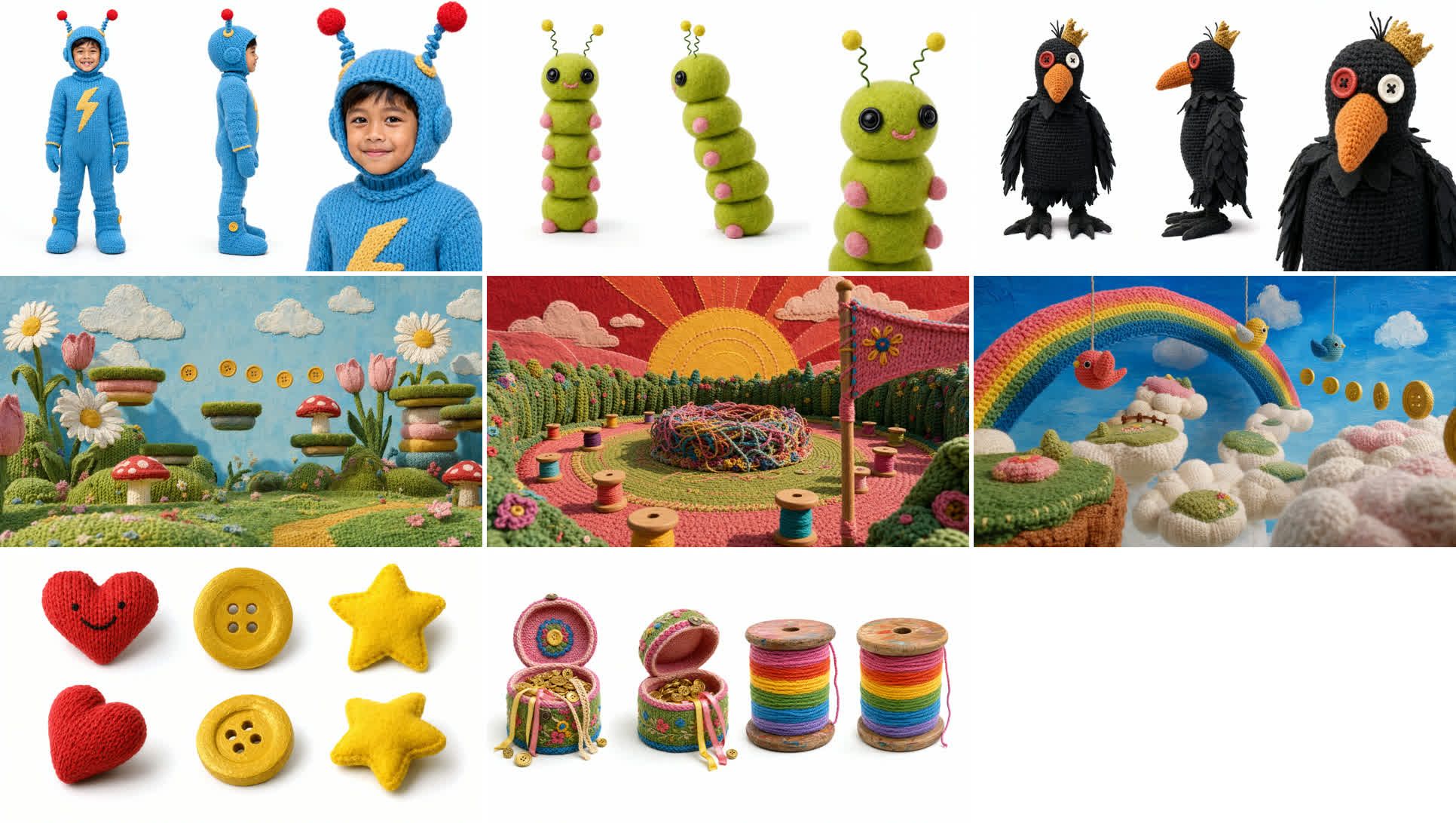
The knitted-game board makes that approach legible. It includes a blue-costumed child, a green caterpillar-like sidekick and a crowned black bird, alongside textile landscapes and collectible shapes. Different views help define the subjects before the model has to animate them. The board documents the supplied material; by itself, it cannot prove that every generated frame retains the same character geometry.
For an actual brief, it is sensible to state which input defines the subject and which defines motion, then review whether unwanted details crossed between them. That review should include costume changes, background leakage and altered proportions. Supplying more references also increases conditioning work and can raise memory demands. The model card warns that accepted input limits do not guarantee every maximum-size request fits GPU memory.
Keyframes can describe composition more clearly than adjectives
Pika’s charcoal-tightrope example combines drawn keyframes with photographic look references. The source board contains five sketches of a performer crossing a rope, plus two photographs. That separates the proposed shot compositions from the photographic appearance the creator wants the result to borrow.
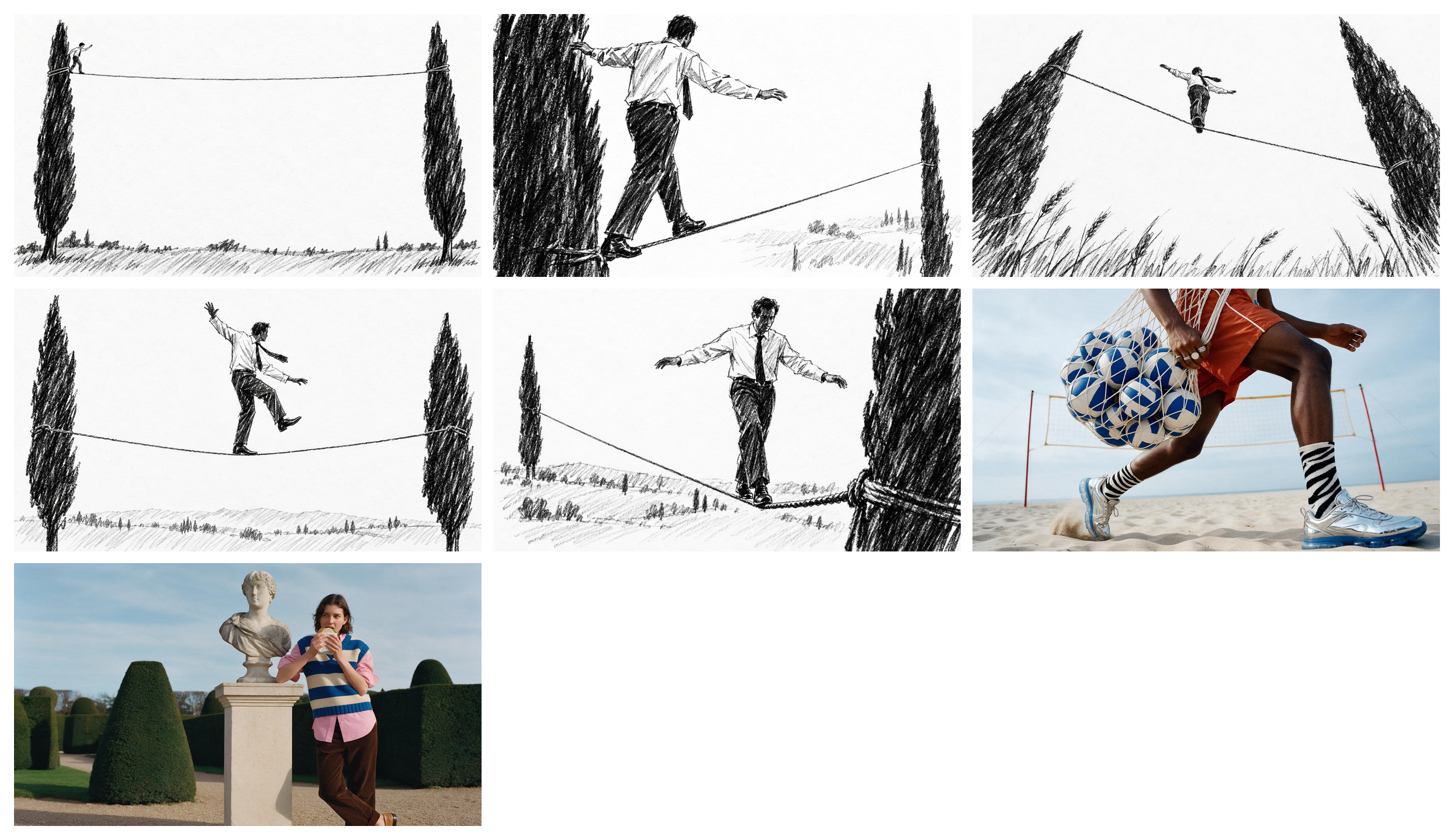
This is a useful production pattern even without accepting a broad controllability claim. A sketch can specify how small a subject should appear, where the rope crosses the frame, or which viewpoint follows another. A written prompt can then concentrate on motion and sound. The result still needs review because the sketches communicate intent rather than imposing a deterministic animation timeline.
The model card is unusually helpful about the status of its showcases: they are creative examples, not release-validation renders or throughput benchmarks. It also says exact reproduction with the released package is not guaranteed. Seeds, exact checkpoint revisions and service preprocessing are unspecified for those examples. A beautiful launch sequence is therefore evidence of a published demonstration, not a reproducibility certificate.
ComfyUI offers a separate, documented integration path
The ComfyUI integration guide documents text-to-video, reference-to-video, and first-and-last-frame templates. They combine the relevant H3 base with a matching Flex adapter. This integration makes the October 29 model release accessible through node-based workflows, while leaving the distinction between local generation and hosted finishing intact.
The guide specifies an lcm sampler, ManualSigmas and CFG 1.0 through BasicGuider for the published six-step path. It advises keeping adapter strength at 1.0 and not stacking an additional turbo or Lightning acceleration adapter. That advice follows the release’s premise: the model has already been distilled for its sampling schedule.
Template compatibility is not uniform. The guide lists ComfyUI 0.43.2 or later for text-to-video, while its reference and endpoint-frame templates list 0.30.0 or later. Users should follow the current template and its required assets rather than treating a minimum version as proof that every older installation has every necessary node.
ComfyUI’s practical notes also qualify the control story. They describe advisory camera amplitude, imperfect cut timing and unreliable fine contact constraints. Asking a hand to stop just short of a surface may still produce contact. Those are useful warnings for designing a shot: a gesture that tolerates variation is a better first experiment than one whose meaning depends on an exact gap between two objects.
Local availability does not mean small hardware
The downloadable release is substantial. Pika’s hardware document asks for at least 211 GB for base components plus approximately 5.5 GB for both adapters, with extra space for dependencies and download staging. Its representative validation uses an H100 with 80 GB of memory. The package runs one request on one GPU and does not shard that request across several GPUs.
In Pika’s reported tests, default 480p, five-second sampling allocated approximately 66 to 69 GiB. Default 768p, 15-second sampling exceeded H100 memory, and the documented alternative uses CPU offload. That offload example allocated roughly 29 to 32 GiB during GPU sampling and observed host memory near 94 GiB including page cache.
These are vendor measurements, not minimum system requirements or benchmarks performed for this article. Pika explicitly notes that the text encoder and video/audio decoders have separate needs and that sampling allocation excludes those stages. The figures should not be converted into a promise that any card with a matching capacity will complete the same request.
ComfyUI’s guide uses its own repacked and quantized components, so its installation route should also remain separate from the Pika CLI measurements. A user comparing options needs to match the actual checkpoint format, offload behavior, request shape and dependency set. The short sampling schedule alone cannot answer whether a particular desktop configuration is suitable.
4K and editable sound are finishing services
Pika’s high-resolution workflow starts with a native draft, then applies an upsampler to the selected result. Calling the output 4K describes the finished resolution, not native 4K generation by the downloadable adapter. Pika says it intends to release the upsampler, but that statement is a future plan, not evidence that its weights are included now.
The five audio stems have a similar distinction. The generator creates a mixed synchronized soundtrack; a prompted separation model then recovers dialogue, score, SFX, foley and ambience. Pika returns those alongside the unchanged video and mix through its hosted service. The local package’s stereo output should not be mistaken for five separately generated production tracks.
For an editor, stems can make a selected clip easier to fit into a larger project: lower the score, keep dialogue, or replace effects. That is the purpose of the separation workflow, not a claim that separation is perfect. Anyone assessing its suitability should listen for leakage and compare the stems with the original mix before committing to post-production decisions.
Check the license before treating the weights as unrestricted
The model card labels the adapters as derivatives distributed under the MiniMax H3 Community License Agreement. That is not a blanket permissive software license. The published text contains territorial exclusions covering the European Union, United Kingdom, Republic of Korea and United States, as well as additional commercial conditions. Prospective users should read the applicable agreement rather than assuming public download access authorizes every deployment.
The repository also distinguishes code, weights and example media. Apache 2.0 coverage for example Python code does not extend to the model weights or showcase imagery. For this report, the reproduced visual boards are attributed source illustrations of the workflows being discussed; they are not presented as freely licensed stock assets or as our own generation tests.
Flex’s immediate value is a documented short-step video-and-audio model with several useful conditioning routes and a clear path into existing creative tools. Its limits are equally concrete: heavy local requirements, imperfect direction following, service-only finishing features, and license conditions that deserve attention before download or deployment. Judge a trial by whether a specific shot survives review, and time the complete path to an editable deliverable rather than the transformer alone.
Sources
- Pika H3 Flex launch announcement, October 29, 2026
- Pika technical deep dive and benchmark definitions
- Official model card, specifications and showcase limitations
- Pika local hardware and tested configurations
- ComfyUI integration guide
- Published model license
- GitHub repository activity snapshot and Hugging Face model activity snapshot
Tags: Pika, Generative AI, AI Video, ComfyUI, MiniMax H3
Supporting keywords: six-step video generation, MiniMax H3 adapters, reference-to-video, ComfyUI Pika workflow, AI video audio stems