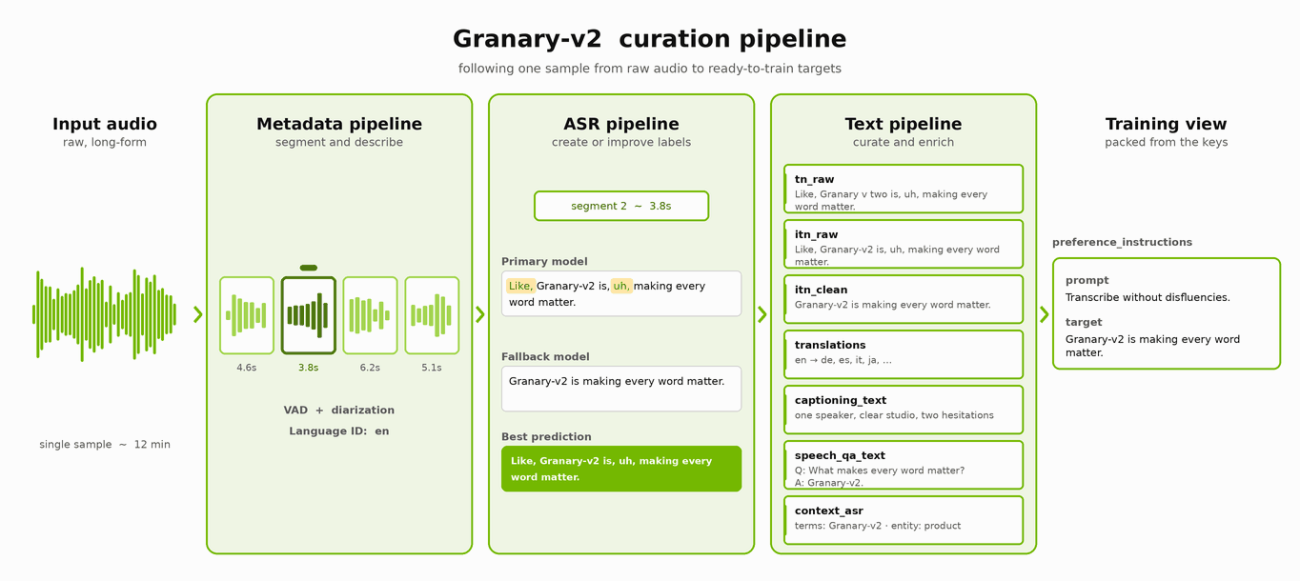
NVIDIA’s Granary v2 release makes a practical distinction that speech apps often hide: recognizing the words and choosing their written form are separate jobs. Released on October 28 alongside Nemotron 3.5 Transcribe, the dataset supplies aligned versions of a recording’s transcript, so an application can learn to preserve spoken hesitations or produce cleaner written text on request.
For a team building searchable interviews or meeting records, that changes the training question. A transcript that keeps every hesitation may suit close analysis of a conversation; a readable record may need a different convention. Granary v2 gives those conventions separate targets rather than treating one rendering as the only correct answer.
| Released field | What the target preserves or changes |
|---|---|
tn_raw |
Text-normalized transcription keeps spoken forms and disfluencies. |
itn_raw |
Inverse text normalization converts spoken forms into written notation while retaining disfluencies. |
itn_clean |
The written-form target also removes disfluencies. |
NVIDIA illustrates the distinction with a payment amount: a spoken number can remain words or become a currency symbol and digits, while a hesitation can remain or disappear. The information belongs to the same utterance, but the requested output differs. For evaluation, the implication is that a team should establish its reference convention before interpreting a transcription error score.
The release extends beyond those transcript variants. Its records can contain captions, speech question-and-answer targets, context terms and translations. Availability varies by record. The dataset card exposes these as fields and instruction-target pairs, making it possible to inspect what a particular example teaches instead of assuming every audio segment has every annotation.
The accompanying Nemotron checkpoint is the downstream demonstration of that approach. NVIDIA says it supports transcription in 40 languages, translation in 31 languages to or from English, and speaker attribution in 13. Those task-specific counts differ from Granary v2’s 48-language dataset coverage. A language appearing in the training-data release does not establish that the model supports every task in that language.
The public download is labels, not the whole audio collection
Two headline sizes describe different scopes. NVIDIA’s research overview reports approximately 843,600 unique audio hours in the full processed collection. The public dataset card lists label manifests covering 463,062 hours across 48 languages and 16 source corpora. The launch announcement explicitly says its public-manifest figures do not describe Nemotron’s full training mixture or sampling weights. Neither number should stand in for the other.
Loading the Hugging Face dataset obtains manifests, not the source recordings. Each record includes an audio identifier; the audio must come separately from its distributor under the applicable access terms and license. This resembles the separation between a reusable representation and its underlying observations in SekaiTech’s OlmoEarth coverage, although Granary distributes speech labels rather than satellite embeddings.
The rights split also follows the material being reused. NVIDIA publishes most released manifests under OpenMDW-1.1, with the People_Speech subset under CC BY-SA 4.0. That exception still applies when those records arrive through the combined English configuration. These terms do not replace the original audio licenses. A single dataset-loader command therefore does not settle permission for an entire training collection.
Quality metadata needs similarly precise interpretation. The card reports approximately 165,300 hours marked high-quality by the pipeline’s own gate. That is an automated classification within this release, not a claim that humans verified every transcript. NVIDIA’s research overview describes model-generated labeling and filtering; SekaiTech reviewed the announcement, dataset card and pipeline documentation without running a speech-training experiment.
The public repository links to NeMo Curator tutorials for preparing metadata, producing ASR predictions and enriching transcripts. Its card also says full end-to-end runs and per-stage scripts will follow. For an initial inspection, a useful unit is one manifest record: which source recording it identifies, which written targets it contains, and which rights apply to the labels and audio separately. That is more informative than choosing the larger hours figure and assuming it describes the download.