NVIDIA’s October 21 Cosmos expansion gives manufacturers a way to create examples of faults they rarely get to photograph. Its Cosmos Data Factory includes a defect-image blueprint for printed circuit boards, metal and glass. For inspection teams, the useful part is the ability to specify the missing training example, such as a solder bridge, rather than wait for a production line to produce one.
That sits inside a larger release of data tools, world-model training resources and simulation checkpoints. NVIDIA lists five Data Factory blueprints, covering driving datasets, image attributes, event videos, surface defects and video augmentation. These address different shortages. Changing the weather in driving footage and adding a missing electronic component are both synthetic-data tasks, but they need different inputs and checks.
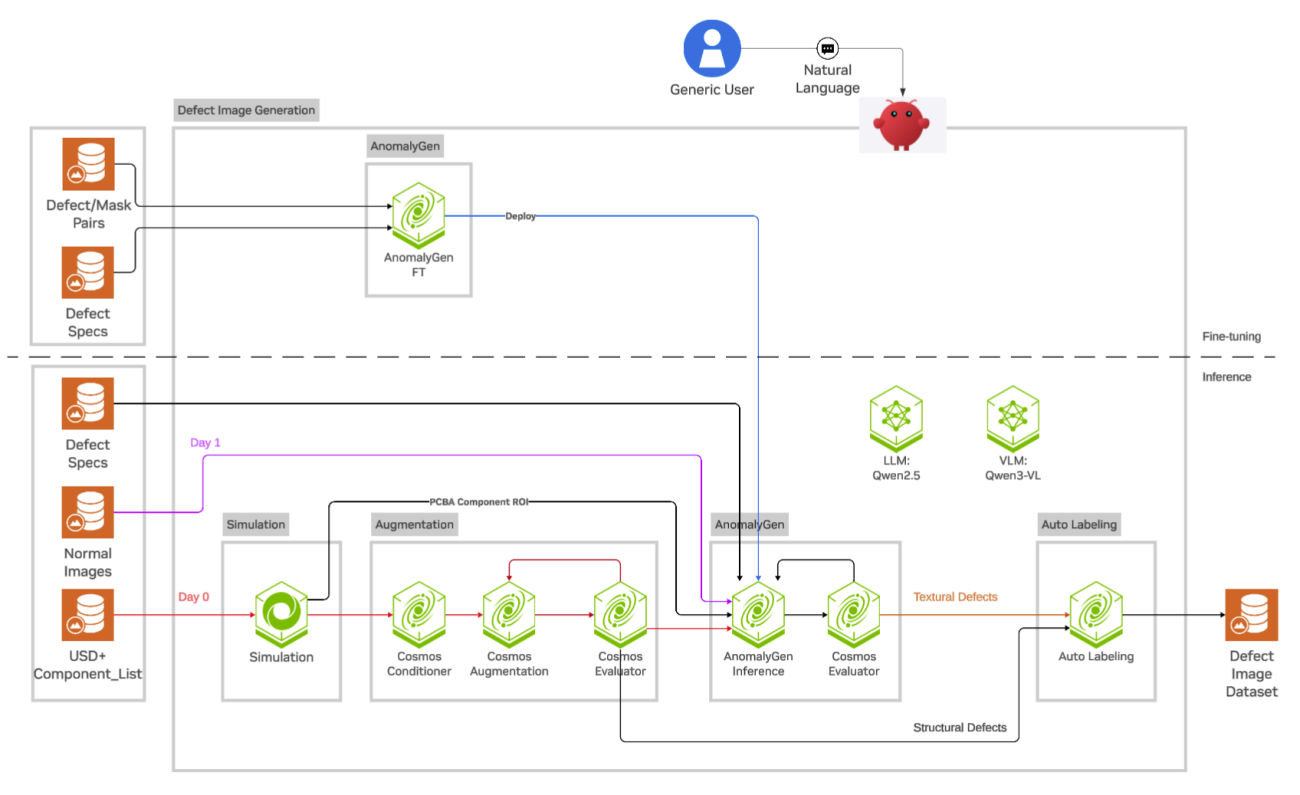
The defect workflow makes that distinction unusually concrete. NVIDIA’s current SMT documentation starts with a board’s 3D scene and selected components. Simulation produces close-up renders; an image-edit service changes their appearance to resemble inspection-camera images. Those clean reference outputs become the starting point for AnomalyGen, which adds the requested defects.
A clean reference is part of the evidence
The documentation calls the clean references golden images. A generated fault has a corresponding clean image, and manifests connect the outputs back to the simulated component and its board reference designator. This is useful for reviewing a dataset: a plausible-looking damaged part is more informative when its origin and intended change remain traceable.
NVIDIA’s full sample selects 24 integrated circuits and 14 capacitors, producing 38 golden images. It requests three defect images: an IC bridge, excess solder on a passive component and a missing passive component. The requested defect count is independent of the golden-image count. These are documented sample settings, not SekaiTech production results or a claim about how many examples a detector needs.
Teams with suitable clean images can also use defect-only mode rather than recreate the whole simulation path. The older OSMO reference workflow, shown in the source diagram above, describes this split as Day 0 inputs from a digital twin versus Day 1 inputs from existing inspection data. The current documentation uses Airflow workflow modes. The diagram explains the input choices; it should not be read as the current deployment specification.
Input identity matters during review. The current guide tells users to exclude the supplied dataset’s own sample-board image folders when preparing certain shared assets. Otherwise AnomalyGen can use those boards alongside the intended inputs, and an output from the wrong board fails full-mode validation. A generated image can look convincing while still belonging to the wrong task.
What a generated defect can establish
NVIDIA says its Cosmos Evaluator checks synthetic video for issues including object consistency and physical plausibility. For the inspection blueprint, the current guide separately asks users to review generated images for geometry and defect preservation before reusing existing inspection labels. Those are specific checks on generated material. They do not establish that a downstream detector will catch a fault on a real factory camera.
The practical distinction is between creating a candidate example and demonstrating inspection performance. A team can use controlled defects to investigate gaps in its training data, then test the resulting model against separately collected real examples. That is an editorial implication of the workflow, not an accuracy result reported here. SekaiTech examined the announcement and documentation; it did not run AnomalyGen or benchmark an inspection system.
This also differs from the model-serving problem in our earlier coverage of Intel’s inference microservices. Data Factory works upstream, on the examples a model learns from. Its defect workflow’s most useful output may be the pairing and provenance around each generated image: which component it came from, which change was requested and which checks it passed before entering a training set.