Microsoft’s Advanced Shader Delivery now supports hardware from AMD, Intel, NVIDIA and Qualcomm, expanding a feature designed to move shader compilation out of the first game launch. The October 21 announcement also puts Steam and the Epic Games Store on the roadmap. That second part is still a plan: broad GPU support does not mean every copy of a game can download its shaders today.
For players, the useful change is a shorter path between installing a supported game and playing it. Microsoft currently directs players to the Xbox PC app for its new Call of Duty: Modern Warfare 4 example, and says Epic will add support to Fortnite in an upcoming update. It has not presented the Steam expansion as already available.
The requirements start with Windows 11 24H2 or later, a listed GPU and a compatible driver. Microsoft’s NVIDIA entry includes all RTX GPUs and RTX Spark with driver 621.01 or newer. Its other entries specify supported AMD architectures, selected Intel hardware and Snapdragon X2 devices. A vendor name alone is therefore too broad a compatibility check.
What arrives with the game
Advanced Shader Delivery, or ASD, is a Direct3D 12 technology. Microsoft Learn describes a pipeline in which developers create a State Object Database, test it by compiling and registering the results, then deploy it to a storefront. The compiled output is called a Precompiled Shader Database. The aim is to provide prepared shaders during the download rather than make the player’s computer compile them at launch or during play.
This explains why a graphics-driver update alone cannot deliver the whole feature. A supported driver is one part of a distribution process that also involves the game’s developer and its installer. The same distinction matters on new machines: the RTX Spark systems covered earlier by SekaiTech appear in Microsoft’s support list, but being eligible hardware does not make an unsupported storefront supply shader packages.
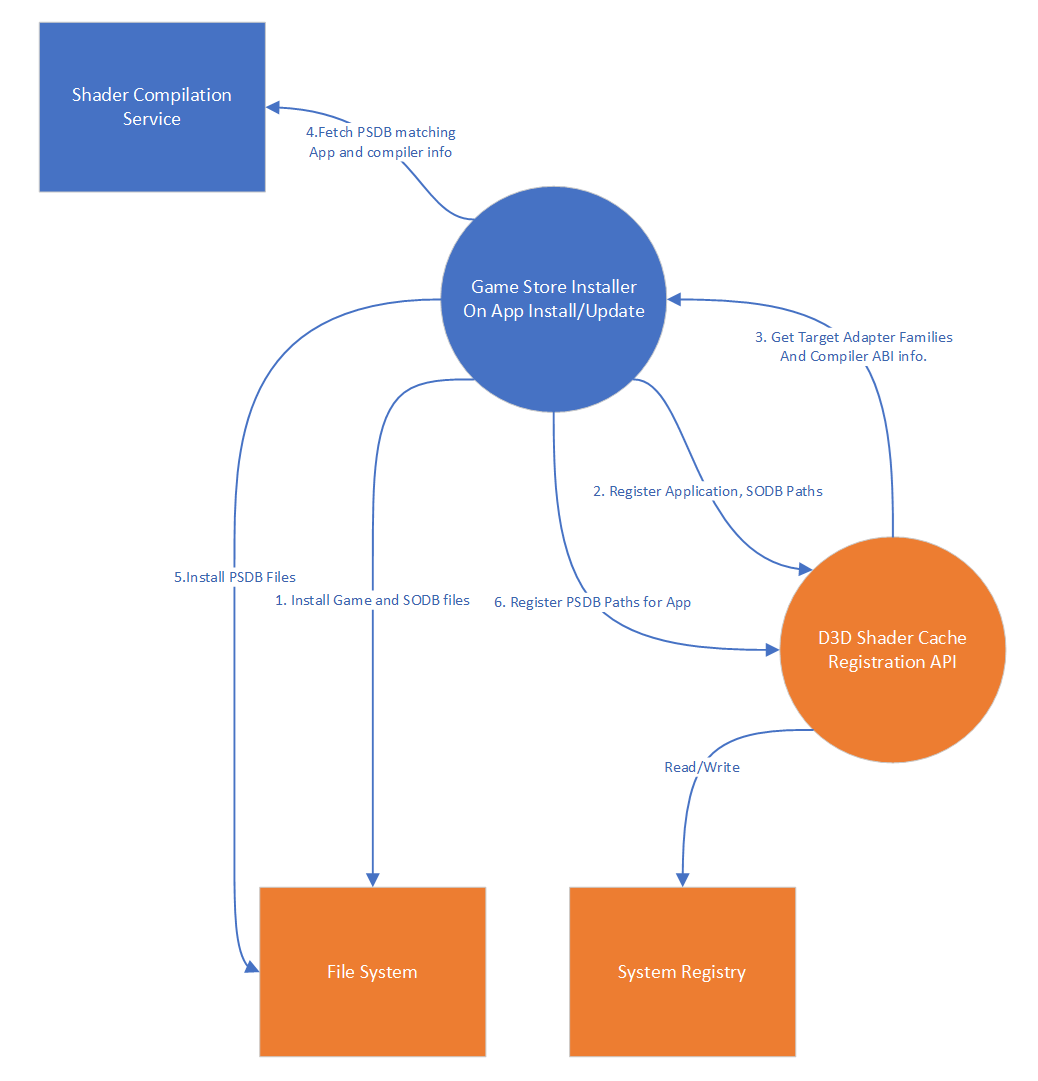
Microsoft’s registration specification shows what the installer contributes. After installing the game and its State Object Databases, it registers their locations, asks which graphics-adapter families and compiler versions to target, and fetches a matching compiled database. It then registers that database for the game. The source diagram above follows this installation workflow; it is not a measurement of loading speed.
There are consequently two different files with different jobs. The developer’s database describes the game’s graphics work. The precompiled database contains results matched to the relevant application and compiler combination. Treating either as a universal cache that can simply be copied between unrelated configurations misses the matching step in Microsoft’s design.
Updates are part of delivery, too
Microsoft’s September developer guide makes an easily overlooked point about maintenance. When game packages and shader databases ship together, players receive the full precompilation benefit. As the game changes and those package versions drift apart, some compilation can return. Developers can address that by uploading a new State Object Database package to match the game update.
That makes shader delivery an ongoing release task, rather than a one-time feature badge. A game can support ASD yet still need fresh packages as its content changes. For a player comparing experiences before and after a patch, the state of those packages is relevant alongside the driver and storefront.
The promise in Microsoft’s overview is narrower than a cure for every hitch: reducing the just-in-time shader compilation that causes shader-compilation stutter. This article examines the published delivery process, not an independent loading-time or frame-time test. The next useful evidence from the storefront expansion will be named supported titles and working distribution paths, so players can tell which installation will actually receive the compiled files.